Connect with us:410-802-1310
Connect with us:410-802-1310

Published in the February 2026 Edition
By Woody Derricks, CFP®,
Accredited Domestic Partnership Advisor


As we begin 2026, investors are facing a familiar but often confusing disconnect: stock markets near record highs, alongside persistent concerns about affordability, job security, and the cost of everyday life. Both views can be true at the same time—and understanding why helps frame realistic expectations for the year ahead.
At the heart of this divide is what economists describe as a K-shaped economy, where financial outcomes differ sharply depending on income level, asset ownership, and industry exposure. This separation plays out not only in the stock market, but increasingly in household finances, consumer behavior, and long-term economic growth.
Where the Economy Stands Today
Growth, Inflation, and Employment
The U.S. economy in late 2025 continued to grow, but at a more moderate and uneven pace than in the immediate post-pandemic years.
These trends help explain why economic headlines often feel contradictory. Aggregate data suggests strength, while individual experiences vary widely depending on income, job type, and financial flexibility.
Stock Markets: Strong Headlines, Narrow Leadership
Market Performance
U.S. equity markets generally advanced through 2025, with major indexes such as the S&P 500 reaching or approaching record levels. However, market gains have been highly concentrated.
A relatively small group of large technology and AI-related companies—led by firms like Nvidia and other mega-cap names—has accounted for a top-heavy share of overall market returns. When these companies perform well, index-level results look strong even if many other stocks lag.
This concentration has important implications:
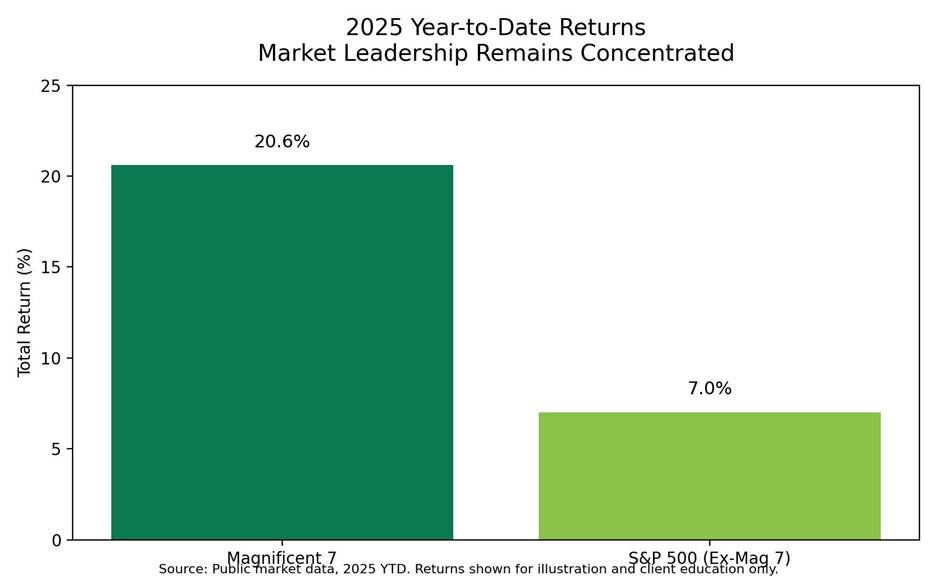
Key takeaway:
A small group of companies is driving a large portion of market gains,
while many others have delivered modest or mixed returns.
The K-Shaped Economy: Beyond Markets
The term K-shaped economy describes a recovery where different groups move in opposite financial directions. This pattern has become increasingly visible—not just across companies, but across households.
Households on the Upper Arm of the “K”
Higher-income households have generally benefited from:
For these households, higher interest rates—while inconvenient for borrowing—have also created opportunities to earn meaningful yields on savings and short-term investments. Their net worth continues to grow, and their ability to buy high-end items has been unaffected.
Households on the Lower Arm of the “K”
Lower- and middle-income households face a different set of challenges:
Even though inflation has slowed, the early-COVID cost-of-living increase significantly raised the floor on most items, and wages have not fully offset that shift for many households. This dynamic helps explain why consumer sentiment surveys show that people are worried about their financial picture despite positive economic data.
Consumer Spending
Consumer spending remains the backbone of the U.S. economy. While overall spending has held up, it is increasingly driven by higher-income households. This creates vulnerability: if stock markets weaken, high-end housing prices decline, or jobs are lost in higher-paying sectors, spending could slow more quickly than expected.
Policy Challenges
The Federal Reserve (the “Fed”) must balance competing forces:
This balancing act becomes more difficult when economic conditions differ so widely across income levels. Until there is more clarity regarding inflation or a significant increase in unemployment, the Fed will continue to walk a fine line on their path to lower interest rates.
What This Environment Means for Investors
In a K-shaped economy, financial planning could matter as much as market performance. Key considerations include:
Strong markets do not eliminate risk, and uneven economic conditions reinforce the value of a thoughtful, goals-based approach.
Bottom Line
As 2026 begins, the economy and markets are best described as resilient, but uneven. Stock market strength has masked meaningful differences beneath the surface—both across companies and across households.
The K-shaped economy helps explain why optimism and anxiety can coexist. For investors, recognizing this divergence is essential to setting realistic expectations, managing risk, and staying focused on long-term objectives rather than short-term noise.
A steady, well-diversified strategy—grounded in personal goals rather than market headlines—remains our suggestion for the year ahead.
Investment advisory services are offered by Partnership Wealth Management, a Securities and Exchange Commission Registered Investment Advisor. The commentary presented herein contains the opinions of the firm, and this information should not be relied upon for tax purposes and is based upon sources believed to be reliable. No guarantee is made to the completeness or accuracy of this information. Partnership Wealth Management shall not be responsible for any trading decisions, damages, or other losses resulting from, or related to, the information, data, analyses, or opinions contained herein or their use, which do not constitute investment advice, are provided as of the date written, are provided solely for informational purposes, and therefore are not an offer to buy or sell a security. Investments in securities are subject to investment risk, including possible loss of principal. Prices of securities may fluctuate from time to time and may even become valueless. This information has not been tailored to suit any individual.
Financial planning is an important part of preparing for the future; contact us today to get started: partnershipwm.com.