Connect with us:410-802-1310
Connect with us:410-802-1310

Published in the March 2026 Edition
By GBMC Healthcare

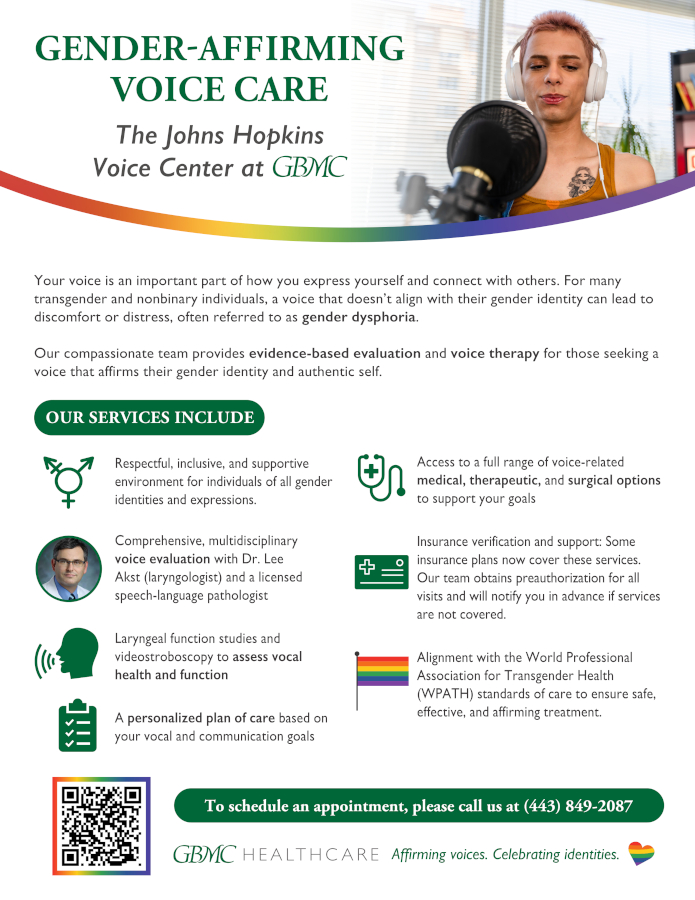
The voice is an important component of self-expression and connection. For many transgender and nonbinary individuals, a voice that doesn’t align with their gender identity can be a barrier to feeling truly seen.
The team at the Johns Hopkins Voice Center at GBMC, part of the Milton J. Dance Jr. Head and Neck Center, provides evidence-based evaluation and voice therapy for those seeking a voice that affirms their gender identity and authentic self.
In this respectful, inclusive, and supportive environment, every patient receives a comprehensive, multidisciplinary voice evaluation with a laryngologist and a licensed speech-language pathologist to assess vocal health and function. Then, the team develops a personalized plan of care based on each individual’s vocal and communication goals.
“Whatever is right for the patient is the right answer,” Melissa Bidlack, MS, MM, CCC-SLP, speech language pathologist and coordinator, said. “We work with the patient to find the voice that feels the most like them without causing strain or discomfort. It's an evolving process. We want to empower the patient to describe the voice they want, and then it’s our job to help them get there.”
With access to a full range of voice-related medical, therapeutic, and surgical options, patients have choices to support their long-term goals.
Surgery is one route, and Bidlack sees patients for pre-surgical and post-surgical therapy to help them understand the mechanism and how to alter resonance and pitch. If therapy is the preferred option, patients can see one of three specially trained and certified speech-language pathologists at GBMC for a series of sessions.
“Once the patient identifies the voice they want, then we try different facilitative methods, leading into words, speech, conversation, reading, even singing if desired, to help them find their individual voice. And, if they are unsure, we work with them to figure it out,” Bidlack said.
Patients often come in feeling frustrated that their voice doesn't match who they are and even traumatized at being misgendered because of it.
“To find a voice that is more representative of their whole being makes them feel a lot more comfortable interacting in public,” Bidlack said. “I’ve had patients express they are more confident and feel more like themselves after voice therapy.”
The team at GBMC provides a welcoming, accessible, and equitable experience for patients seeking this specific voice treatment. Voice is deeply personal, and their mindset of continuous learning underscores their commitment to serving patients the way they need and desire.
Affirming voice care is rooted not just in the voice itself, but in what the person behind it is saying. At GBMC, individuals are met with expertise, compassion, and choice in finding a voice that feels truly their own.